

Cartridge Mould
What is Cartridge Mould
Cartridge mould are the tools that shape and cut sheet metal parts. They are commonly developed using computer-aided design (CAD) software and analytical programs to create and prove-out highly accurate, unambiguous designs. These designs are then translated into stamping dies by skilled craftsmen, known as diemakers.
Benefits of Cartridge Mould
Cost-effective: Cartridge mould are highly efficient and cost-effective in mass production. They allow for rapid and consistent production of parts, reducing labor costs and increasing overall productivity.
High precision: Cartridge mould are designed to produce high-precision components and parts. They enable manufacturers to achieve tight tolerances and ensure accurate and consistent dimensions in each stamped piece.
Versatility: Cartridge mould can be used to produce a wide range of complex shapes and sizes. They are adaptable to various materials, including metals, plastics, and composites, making them versatile for diverse manufacturing applications.
Speed: Cartridge mould enable high-speed production, as they can rapidly stamp out multiple parts in a short period. This helps to meet production demands and reduces lead times.
Durability: Cartridge mould are typically made of hardened tool steel, which makes them highly durable and long-lasting. They can withstand high-pressure forces during the stamping process without losing their shape or functionality.
Automation: Cartridge mould can be integrated into automated production systems, increasing efficiency and reducing the need for manual labor. This leads to improved safety, reduced human error, and increased production rates.
-
7.62mm Mould
The company produces and sells all kinds of mold products, including full sets of equipment molds
-
5.56mm Mould
Due to the different follow-up processes in different countries, the requirements for cups are also
-
Deep Stamping Die
The company produces and sells all kinds of mold products, including full sets of equipment molds
-
Stamping Metal Die
The main purpose of this product is military use. Its advantage is to reduce production costs on
-
Metal Mould
The company produces and sells all kinds of mold products, including full sets of equipment molds
-
Military Mould
We firmly adhere to the business philosophy of taking customers as the base point, quality as the
-
Military Mold
The company mainly sells gilding metal clad steel strips, copper strip, copper rod, copper tube,
-
Metal Die Press
The products are applied to military industry, low-voltage electrical appliances, electronics,
-
Die and Stamping
The company specializes in designing and manufacturing all kinds of stamping supporting molds and
-
Metal Stamping Mold
The products are applied to military industry, low-voltage electrical appliances,


Why Choose us
Well Equipped
Our company has a compound rolling mill, 20 roll finishing mill, 950 six-high finishing mill, 23-high stretch bending and straightening machine, bell-type annealing furnace, continuous annealing furnace, pickling line and other production equipment have obtained a number of technical achievements and practical patents.
Quality Assurance
GJB9001C-2017 Weapon Equipment Quality Management System .
ISO9001-2015 Quality Management System.
Quality services
Our team is committed to delivering high-quality services to our clients. We use the latest technologies and tools to ensure that our services exceed your expectations.
Experience and expertise
Our company has been in business for many years and has amassed significant expertise and experience to provide quality services to our clients.
Common types of Cartridge Mould: engineering molds, continuous molds? What is the difference between them
Stamping single engineering mold
Only one process is performed on a punching machine, such as bending, embossing, punching, drawing, stretching, beaming, curling and crimping. For example, the article only needs to be cut into one shape, but the required thickness is very thick, and it is possible to use an engineering die to punch.
Because the engineering molds are common in application, the structure is simple, the manufacturing is easy, the price is cheap, but the production efficiency is low. The stamping technician will put the metal plate on the punch press and press the start button with the foot to let the mold punch down.
However, because most of them rely on manpower, they are slow and can easily cause work injuries.
It is recommended that RD or the procurement engineer should also confirm whether the stamping factory has equipment to prevent work injuries when searching for the stamping factory, such as safety guards and infrared detecting devices.
The work injuries caused by such stamping are usually fingers or whole palms. Broken. If you are looking for a supplier, there is one more security requirement that will allow more Taiwanese workers to have more protection.
Stamping continuous mold
As mentioned earlier, engineering molds are less efficient, slower, and mostly manual. In order to improve efficiency and productivity, continuous mode is produced.
The biggest difference between continuous die punching and engineering die punching is that the continuous die uses the strip and automatically feeds the punch to the press, so the technician can reduce the number of times the handle is put into the punch, which is safer.
In addition, the advantage of the continuous mold is that it can complete multiple processes on one press machine. For example, flex + embossing + punch cutting + extension + stretching + beam mouth + curl + curling.
However, because there are many processes to consider, the complexity of the mold design will be higher, and the cost of the mold will be more expensive. However, in this way, the original three processes are to open three sets of molds in the engineering mold.
Now it is only necessary to open a set of continuous molds, and if there is a large demand for production, the stamping cost of each part is cheap. More and more cost-effective, the production speed is still relatively fast.
The Cartridge Mould Processes
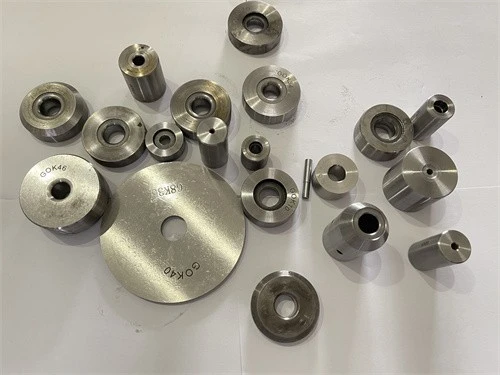


Cartridge mould is the process of making pressure on the blank so that the blank will undergo steel transformation or separation to produce workpieces with fixed sizes, shapes and properties.
The cartridge moulds are made according to the processes of traditional milling or high speed, to reach the shape are used for 7-axis milling machines. The active parts of the cartridge mould are also used as electrical discharge machines (wire or tuff), lathes, and grinders.
In the precision metal stamping field, the cartridge mould must usually be designed without cavities that might restrict the removal of the piece: in particular, undercuts are to be avoided, that is, angles of 90° or more, which in fact make the printed indivisible element from the cartridge mould.
The stamp of a cartridge mould must pay particular attention to the draft angles: since the creation of the walls perfectly in axis with the extraction movement could give problems in the removal of the finished parts, the walls should never be designed vertical but must have a slight angle (1 or 2 degrees) to the outside. To exemplify, a cylinder should be converted into a truncated cone in order to be extracted without problems.
In the molding of sheet metal, the cartridge mould is made from a steel block, divided into two parts, one on the base and the other on the movable part of the machine tool, which deforms the material to obtain even with subsequent steps (and with molds gradually slightly different) the final shape of the piece industrial.
A process of precision cartridge mould stamping is known as deep drawing. It is a very difficult task, which must be divided into several steps to prevent the sheets from being stretched excessively and therefore can tear or bring thinning non-uniform.
Punch
The punch is the action star of the cartridge mould assembly. It's the part that moves and shapes the metal. Imagine a sculptor's chisel, precisely carving out shapes.
The punch interacts directly with the metal, performing operations like cutting and forming. It's tailored to the specific task at hand, whether creating a hole or shaping a contour.
Die Block
The cartridge mould block is the foundation, the bedrock upon which all else rests. It's a solid piece of metal that holds the cavity or form into which the metal sheet is pressed or punched.
Think of it as a mold that gives shape to the molten metal. It's customized for each project, ensuring that the final product meets the exact specifications.
Stripper
The stripper is like the unsung hero, often overlooked but vital. It's the component that strips or removes the metal part from the punch after each stamping action.
It ensures smooth operation and prevents the metal from lifting or sticking to the punch, which could cause damage or inaccuracies.
Pilot
Pilots are the guides, the navigators of the stamping process. They ensure precise alignment of the metal sheet as it moves through the cartridge mould.
Like a captain steering a ship, pilots ensure that each operation occurs at the correct location, maintaining the integrity and accuracy of the part.
Guide Pins and Bushings
Guide pins and bushings are the stabilizers. They keep the upper and lower parts of the cartridge mould aligned. It's crucial for the cartridge mould to close correctly each time to avoid any misalignment or damage to the parts.
Think of them as the shock absorbers and alignment system in a car, essential for a smooth and accurate journey.
Springs
Springs are the hidden energizers. They provide the necessary force to components like strippers or pressure pads, ensuring they return to their original position after each stamping cycle.
They're like the springs in a mattress, providing support and resilience, ready for the next action.
Pressure Pads or Hold-Downs
Pressure pads or hold-downs are the peacekeepers. They hold the metal sheet firmly in place during the stamping process. It's crucial to avoid any movement or slippage, which could lead to defects or inaccuracies.
These components ensure a stable and secure environment for precise stamping.
Materials Used for the Cartridge Mould
Tool Steel
Known for its hardness and durability, it can withstand high-pressure environments and repetitive actions without wearing down quickly. This makes it ideal for high-volume production runs where precision and longevity are paramount.
Carbide
Carbide, the diamond in the rough, offers even greater hardness and resistance to wear than tool steel. It's particularly useful for high-precision or high-wear applications. However, this toughness comes with a higher cost and brittleness, making it a choice material for specific, demanding applications.
High-Speed Steel
High-speed steel is the sprinter of cartridge mould materials. It's tougher and more resistant to heat than standard tool steel, making it ideal for high-speed applications.
This material can handle the heat and pressure of fast-paced stamping operations without losing its edge.
Powdered Metals
Powdered metals are the alchemists' blend. These materials are made by blending powdered metal and heating them to form a solid.
This process allows for the creation of materials with specific properties, such as increased toughness or wear resistance, tailored to specific stamping needs.
Shock-Resisting Steel
Shock-resisting steel is the shock absorber of the cartridge mould world. It's designed to withstand sudden impacts and vibrations, making it ideal for operations involving heavy or abrupt forces. This material helps in reducing wear and tear on the cartridge mould, ensuring a longer lifespan.
High-Carbon, High-Chromium Steel
High-carbon, high-chromium steel is the fortress of cartridge mould materials. It offers excellent wear resistance and is capable of maintaining high precision over extended periods. This material is particularly suitable for detailed work that requires a high level of accuracy.
The Basic Uses Of Cartridge Mould
Cartridge mould are placed in sheet metal panels either alone or as a series of presses in a press line. Cartridge mould and presses can have different input variables on the bases of tonnage, press parallelism, shut height, nitrogen pressure in cartridge mould, counterbalance pressure and press speed. These variables can influence the quality of the stamping panel, particularly during die setup. The same stamping press can be reused by replacing one set of cartridge mould with another.
The placement of cartridge mould in a press is known as die setup. Die setup decides the shut height and binder force. The number of components produced in a die setup is known as a batch.
There are many different kinds of dies such as single station dies, multiple station dies, compound dies, progressive dies and tandem press lines. Most dies are designed by the metal stamping companies who use advanced technologies like CAD to design them according to customer specifications. Another classification of dies is draw dies, trim dies and cam-pierce dies.
Cartridge mould are the devices used in metal stamping machines. Each metal stamping machine can have one or more than one cartridge mould depending on the kind of machine. Cartridge mould are the main components in metal stamping machines that do the actual casting, punching, cutting and shaping of the metal sheet.
The basic cartridge mould operations are drawing, shearing and bending. In metal stamping, the metal sheets are placed in a cartridge mould or a press tool which has a specially designed cavity that gives the preferred shape to the metal sheet. The upper part of the cartridge mould connects to the press slide while the lower component connects to the press bed. A specific component known as the punch pushes the metal sheet through the die, thus performing the actual shaping operation. The patterns on the dies can be used to emboss or give three-dimensional lettering on the final product.
NINGBO ESTAR METAL MATERIAL CO.,LTD is a domestic research and development, production, sales of science and technology companies.
The company mainly sells gilding metal clad steel strips, copper strip, copper rod, copper tube,and other raw materials. Copper cups, steel cups, gilding metal clad steel cups and other military stamping products. The company specializes in designing and manufacturing all kinds of stamping supporting molds and selling production equipment and machines. The products are applied to military industry, low-voltage electrical appliances, electronics, communications, house appliances and other fields. The company maintains close cooperation with many domestic and foreign military enterprises, and its sales network covers the world.


